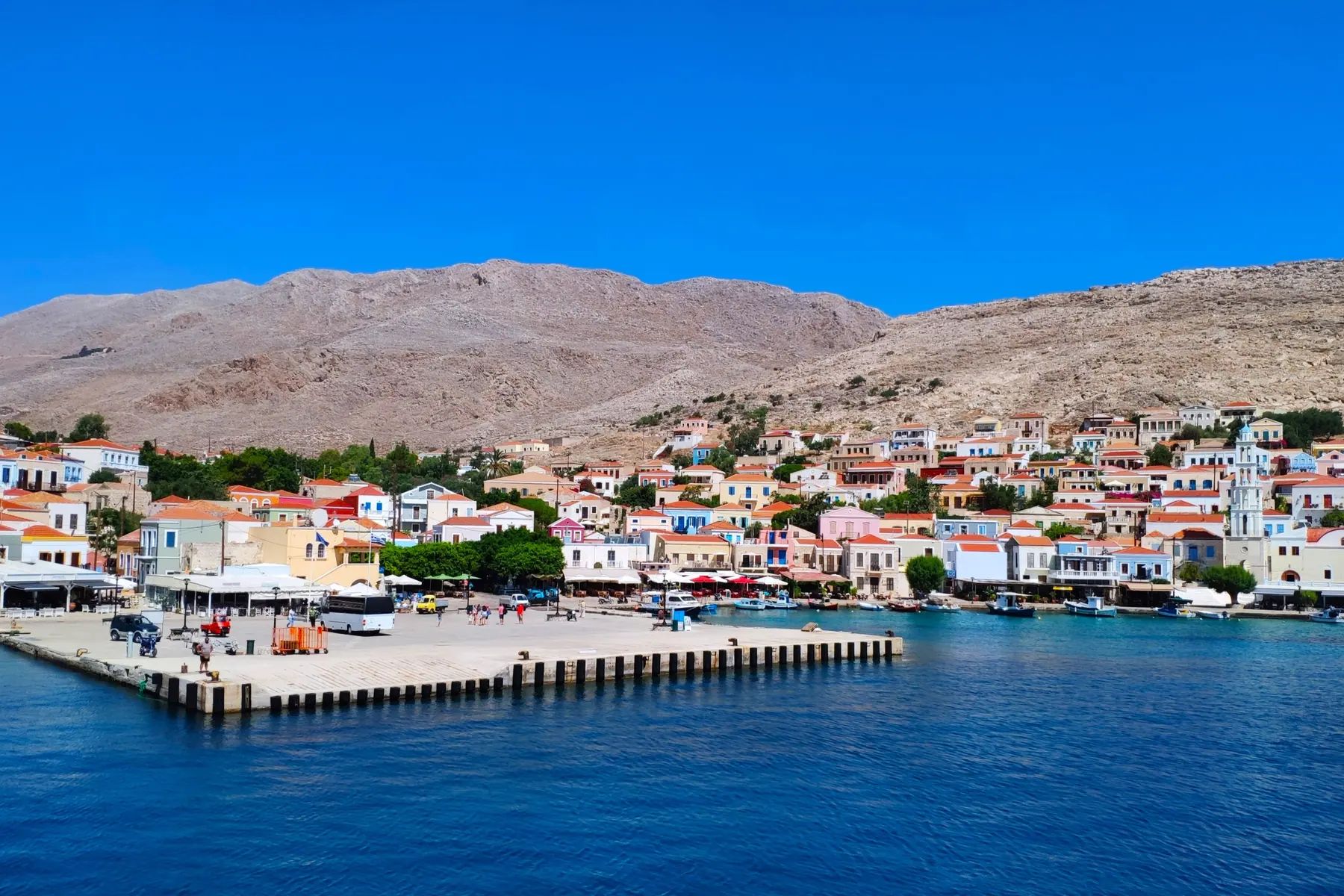
In 1983, UNESCO designated Chalki as the ‘island of peace and friendship’. Never has a title been so apt. With just 300 or so permanent inhabitants, no large hotels and just 25 square kilometres, this limestone speck to the west of Rhodes should satisfy the annual search for Greek island escapism.
Emborio is the island’s only town and port of arrival. Quaint and traditional, the distinctly Italian-looking houses, Town Hall and graceful bell towers are arranged in ascending tiers around the sweeping bay. The seafront is home to a very reasonable choice of tavernas and cafes interspersed by a handful of mini-markets, bakery, bars and a few gift shops that sell craftwork and jewellery. A wander amongst the cobbled, whitewashed alleyways away from the waterfront will bring visitors into contact with the local population who still go about their daily lives, be it fishermen mending their nets or local craftsmen renovating original Venetian villas. It has to be said that Chalki is not blessed with the pick of beaches in Greece. The best is probably Pondamos, a gentle stroll 15 minutes to the west on the village. Here, a meagre strip of shingly sand and small pebbles is made considerably more acceptable by stunning surrounding scenery and a waterside taverna.
In contrast, it must be said that Chalki is blessed with stunning landscapes that will perfectly complement gentle ambles as well as keen hiking. These vistas are made easily accessible if one uses the asphalted road that runs for 7 miles west of Emborios. The old, pirate-proof village of Chorio is only about an hour away from Emborios and it is well worth climbing a path for 10 minutes or so from here up to the old crusader castle to take in the most wonderful views. More intrepid walkers will venture further west to the Monastery of St. John although it is also possible to make this visit as part of a low key excursion. An excellent walkers’ map can be purchased on Chalki which details all these walks plus other exciting walking possibilities to the north of the island.
Things to do
Minibus from Emborio to beaches and excursions to Chorio and Monastery of St. John. Caiques, excursion boats and taxi boats from Emborio to beaches and caves on the south coast as well as the neighbouring, deserted island of Alimnia.
Getting there
Travel between Rhodes and Chalki is by ferry (1 hr. 15 mins.).
| Leg | By | Roughly |
|---|---|---|
| Rhodes → Chalki | ferry | 1 hr 15 min |
Crossing times are the scheduled durations of the route, not a timetable. Sailings vary by season and operator.