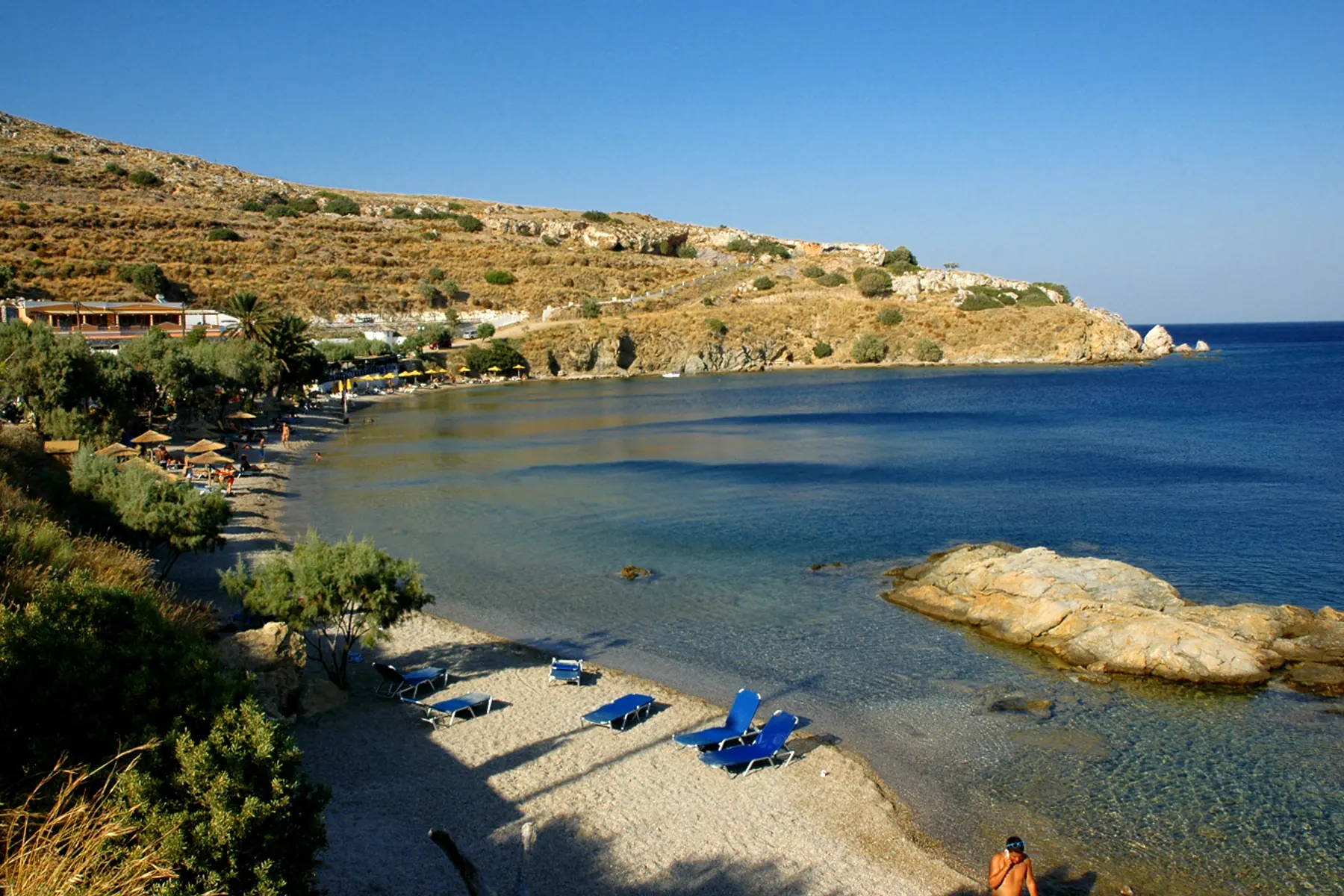
9 miles long and 4 miles wide, the barren hills and fertile valleys of oak, eucalyptus and pine of Leros slope down to a deeply indented coastline of secluded beaches surrounded by numerous islets. Leros is by no means a typical Greek island. Italian rule between the two world wars has bequeathed the island a distinctive Italian feel with colourful, 1930s buildings and wide, tree-lined boulevards the most obvious signs of this influence. The main port of Lakki on the west coast manifests these characteristics more so than any other town on Leros but it is the stretch of east coast between Alinda in the north and Platanos in the south where most visitors end up staying. Platanos, also known as Chora, straddles two hills, one of which is crowned by a Knight’s castle. Neoclassical buildings are draped along this ridge which drops down, seamlessly to the island’s second port of 19 C.
Aghia Marina. An attractive waterfront with small quay, several tavernas, shops and pebble beach should not distract visitors from exploring the rest of the village inland. Considered to be one of the best-preserved, traditional villages in the Greek islands, Aghia Marina enjoys a stunning amphitheatre setting in the hills. The coastal walk north from Aghia Marina to Alinda Bay only takes 25 minutes. Recognised as the longest-established resort on Leros, Alinda’s wide choice of eating establishments and shingle beach are the mainstay of attractions although one can also visit the 1943 Allied War Graves Cemetery close to the south end of the beach and the historical museum housed in the Bellini mansion. Included amongst the exhibits in the museum are items of folklore interest, archaeological finds from Neolithic and Bronze ages as well as military exhibits from World War Two.
Wedged between Alinda (15 minutes walk) and Agia Marina (10 minutes walk) lies Crithoni Bay. Here, little disturbs the tranquillity though a couple of tavernas save the walk to the busier northern or southern bays. Coastal walkers will venture south of Platanos to attractive Pantelli and Vromolithos Bays, both of which possess beach and eating establisments.
Things to do
Bus tours of the island and day trips to Patmos, Lipsi & Kalymnos. Leros’ seabed is dotted with the wrecks of numerous World War Two warships.
Getting there
Travel between Samos or Rhodes and Leros is by ferry (6 hrs. 05 mins. or 4 hrs. respectively).
| Leg | By | Roughly |
|---|---|---|
| Samos → Leros | ferry | 6 hrs 5 min |
| Rhodes → Leros | ferry | 4 hrs |
Crossing times are the scheduled durations of the route, not a timetable. Sailings vary by season and operator.