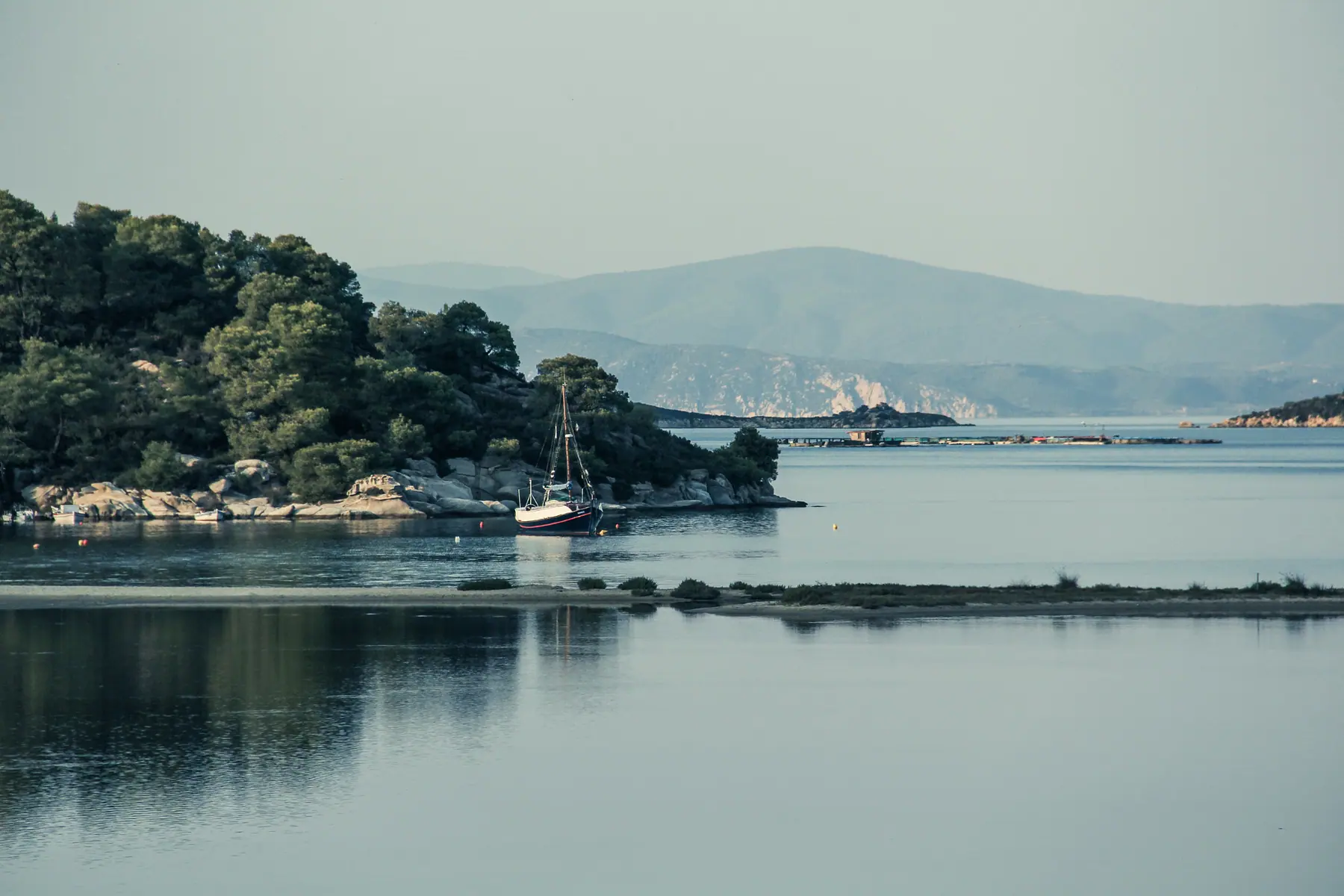
Three fingers of land separated by two massive, horseshoe-shaped bays form the peninsular known as Halkidiki. It is a region vastly rich in beautiful landscapes, attractive coastlines, quaint villages and a powerful, historical past. The western prong, known as Kassandra, contains the most tourist development whilst Sithonia, the central finger of land, is less developed. Athos is the furthest east and is home to the holy mountain of the same name where monasteries occupy remote locations on high cliffs. From a base on Kassandra or Sithonia, or on a driving route of its own, it is also possible to reach northern Halkidiki, a vast area that lies between Thessaloniki and the Halkidiki peninsulars. The traditional village of Arnea and the region’s main town, Polygyros, both sit close to the Holomondas mountains, which rise to 1,165 metres. With wonderful views, dense forests and a variety of national parks, this is an area of outstanding beauty.
This is the most visited part of Halkidiki, and the east coast is the busier of the two sides. The village worth aiming for, well away from the mass-market resorts, is Afitos on the east coast, one of Halkidiki’s most traditional villages, and one that has kept its character. Within the cobbled streets of Afitos one will find the temple of Ammon Zeus Dionysos, a Byzantine church and plenty of tavernas and cafes with excellent views across to Sithonia with the summit of Mount Athos visible on a clear day. A sandy beach is located about 10 minutes’ walk from the centre of the village. It is possible to visit all the attractions of Kassandra from Afitos. Numerous sandy beaches, a wine factory and the natural hot baths of the spa town Loutra are all within range.
More rugged, better cultivated and less developed than Kassandra, the pine forested slopes, olive carpeted coastal groves and small sandy inlets of Sithonia bestows the area a completely different feel to its western neighbour. Two places on the west coast make the best bases. Nikiti, the more northerly of them, has two very different parts. To the western side of the coastal road lie the long sandy beach and a wide selection of cafes, restaurants and tavernas. By contrast, time in the eastern, original and traditional part of the village seems to stand still. Akti Elia beach lies just outside it. The second is Neos Marmaras, further south on the west coast. This small fishing port has a fine selection of cafes and tavernas and a small, sandy beach. The longer sandy beach of Paradissos is about 15 minutes’ walk away. Like Kassandra, it is possible to drive around the peninsula from either. The eastern coastline is very undeveloped but it is possible to take daily excursions from Agios Nikolaos to view the monasteries of Mount Athos from the sea.
Halkidiki can be combined with Athens, Chios, Crete, Lemnos, Lesvos, Mykonos, Rhodes, Samos and Santorini. It is possible to arrange two centre holidays combining Kassandra and Sithonia. A stay in Thessaloniki itself can also be arranged.
Halkidiki is a driving destination. The three peninsulas are too far apart to work from a single base without a car, and the coast roads are the point of going.