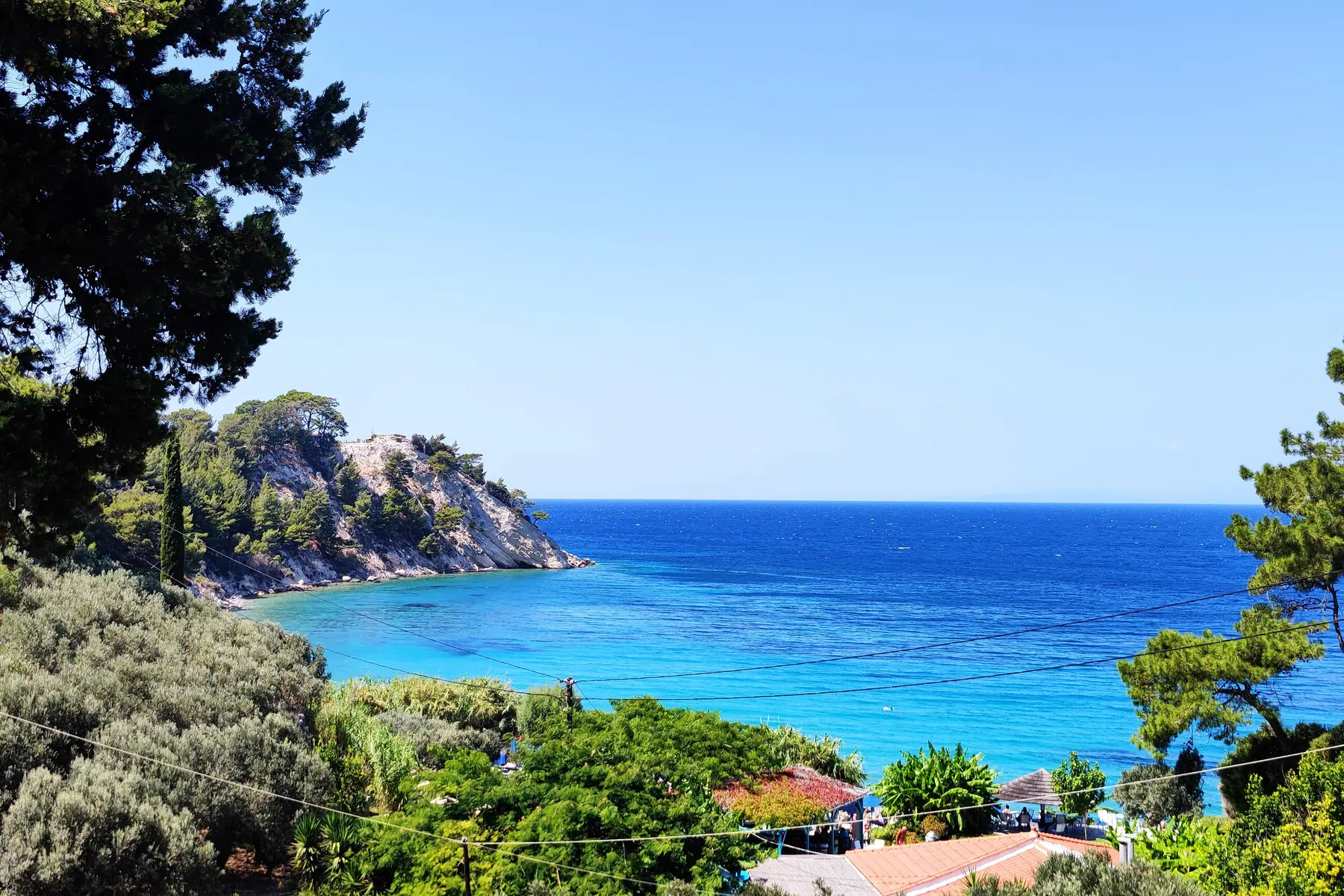
With 100 miles of coastline, many beaches, craggy highlands, burbling brooks by traditional villages, picture-postcard seaside villages and ports and access to some of the most imposing ancient sites in the eastern Aegean, Samos can truly claim to offer something for everyone. With direct flights from London Gatwick and Manchester, these many delights can be reached in just under four hours. By the same token, the international airport also makes Samos one of the busier islands in the eastern Aegean.
You will find Greek Sun’s accommodation in four completely different areas of Samos, all with their own character and ambience. On the north coast, Kokkari is probably the most attractive coastal village on Samos. Three pebble beaches, a delightful waterfront lined with colourful cafes and tavernas and some of the best walking possibilities in the hilly hinterland make this area the first choice of many.
The more sheltered Votsalakia on the south west coast loses the cosmopolitan village atmosphere of Kokkari but gains a superior sand/shingle beach that stretches for nearly 2 miles bestowing on it a more conventional, beach resort atmosphere complete with a good choice of tavernas, cafes, bars and shops.
Five miles to the west of Votsalakia, Limnionas, by contrast, is a very peaceful holiday location. The beach is among the best on Samos and there is little tourist development to spoil the wonderful scenery of Mount Kerkis, the lower slopes of which offer more wonderful walking opportunities. Dining is limited to 4 tavernas and the local mini-market provides most other holiday essentials.
Antiquity, and one very good tunnel
Samos is large: 477 square kilometres, forty-three kilometres by thirteen, and separated from Turkey by the Mycale Strait, which is a mile and a half of water. That size is why a single base does not cover it.
Two of the ancient sites are a UNESCO World Heritage listing between them. The Heraion, the sanctuary of Hera on the south coast, and Pythagoreion, the ancient city under modern Pythagorio, are inscribed together, and the item inside them worth going out of the way for is the Eupalinian aqueduct: a tunnel a kilometre long, dug through a mountain from both ends in the sixth century BC by two teams who met in the middle. A stretch of it is open to walk.
The island produced Pythagoras, Epicurus and Aristarchus, the first person known to have put the sun at the centre, and it made a name in antiquity for its wine, which is still made here. Its modern history is unusual as well: from 1835 until union with Greece in 1913 Samos was a semi-autonomous principality under Ottoman suzerainty.
Things to do
By far the most popular excursion is the guided tour to the magnificent ancient city of Ephesus in Turkey which dates from the 11th century BC and uses the Turkish port of Kusadasi as its gateway.
Other possibilities include a splendid day trip to the neighbouring island of Patmos and a jaunt across to the islet of Samiopoula where beach and taverna await. Water sports facilities are low-key, the most organised being a windsurfing base at Kokkari. Tours of Samos island are arranged by coach, guide included.