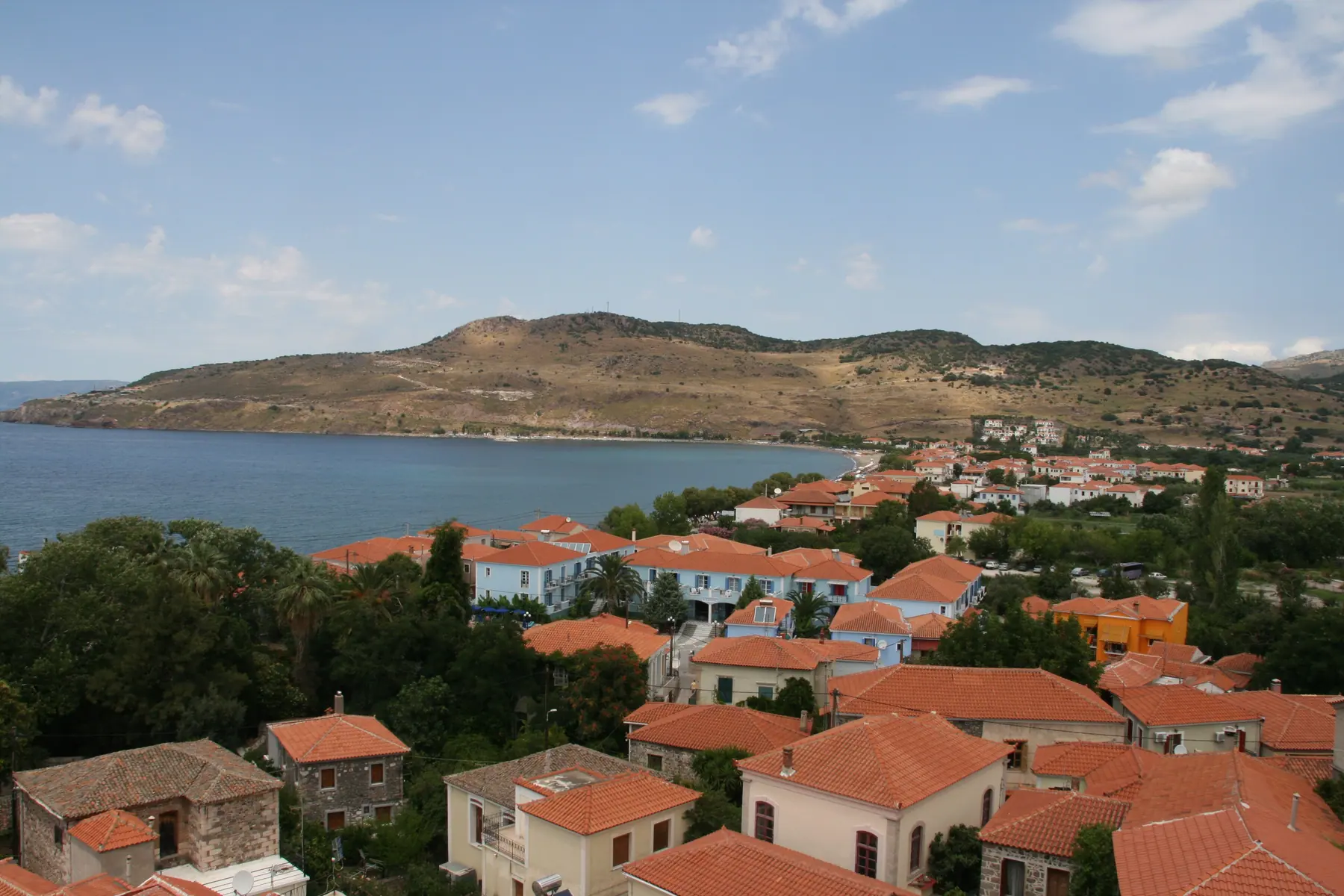
Where does one start describing Greece’s third largest island? In fact, how does one ‘visit’ and do justice to an island that can boast medieval and Ottoman architecture including castles from the late 14th century, not to mention the varied scenery that shifts from vast olive groves (some over 500 years old) to oak and pine forests to stark, apocalyptic, parched, boulder-strewn hills. Then there are the beautiful inland monasteries, the equally alluring hillside villages or the coastal regions where most of the island’s rooms are. The distances defeat a single-base trip: staying put in one village means seeing a fraction of Lesvos. Two bases work, three or four work better, and a car is close to essential, because without one large parts of the island are simply out of reach.
Lesvos works from three main centres plus the island’s capital and port, Mytilini, which is the place to start. Mytilini is stimulating more than it is pretty. Straddling a promontory capped with an impressive castle, this busy harbour town’s skyline is dominated by the pineapple-domed church of Agios Theodoros and is full of friendly locals and hardly any tourists. Immersing yourself in local Greek life comes easily here.
By complete contrast, a drive one hour and forty minutes north west of Mytilini will reveal Molyvos, Lesvos’ most famous village and tourist capital. It is easy to see why Molyvos is so attractive to the holiday maker. The small, taverna and café lined fishing port can adorn any picture postcard with ease. Likewise the backdrop of red-roofed mansions that cover the hillside and secret narrow, vine-shaded alleyways which in turn contain a myriad of shops and tavernas that snake ever upwards to the Genoese fortress.
Sigri, on the extreme western coastline of Lesvos, is a one hour 20 minutes drive south west of Molyvos. Whereas Molyvos is the island’s tourist capital, Sigri is a quiet haven, attracting far, far fewer visitors by virtue of its seclusion. A small port, home to the local fishing fleet and overlooked by an Ottoman castle, a smattering of low key tourist accommodation, the obligatory handful of tavernas and shops and a tree-fringed, sheltered sandy beach are what visitors can expect.
Last and far from least are Plomari and the neighbouring hamlet of Agios Issidoros on the south coast, two hours and 25 minutes drive time from Sigri. Plomari and Agios Issidoros manage to combine the best attributes of Mytilini, Molyvos and Sigri. Plomari itself is sustained by a vibrant economy anchored on the local ouzo distillery and farming and has little need of tourism, though visitors are made extremely welcome. The town’s scenic appeal is centred on the attractive harbour and tree-shaded, café-lined promenade. A pebble/shingle beach is located just 10 minutes walk from the town centre. Walk 25 minutes along the coast road to the east of Plomari and one enters the small tourist hamlet of Agios Issidoros. Here, there is a more conventional but low key tourist atmosphere. A long pebble/shingle beach is the area’s mainstay attraction along with a reasonable selection of tavernas, cafes and local tourist shops.
No single page does justice to Lesvos. A good guide book earns its weight here, particularly on a trip that moves between bases rather than staying put.
Things to do
From Molyvos there are a number of boat trips including the short hop across to Pergamon in Turkey. If you tire of driving or have chosen not to have car hire, some of the local traditional villages are included in bus tours as well as Mytilini. Molyvos is also home to a diving school that welcomes both beginners and experienced divers alike.
Sigri and Plomari/Agios Issidoros are not so organised when it comes to such activities, but with your own car it is possible to make your own day trips whether it be to a beautiful monastery, traditional village, Petrified Forest or deserted beach.