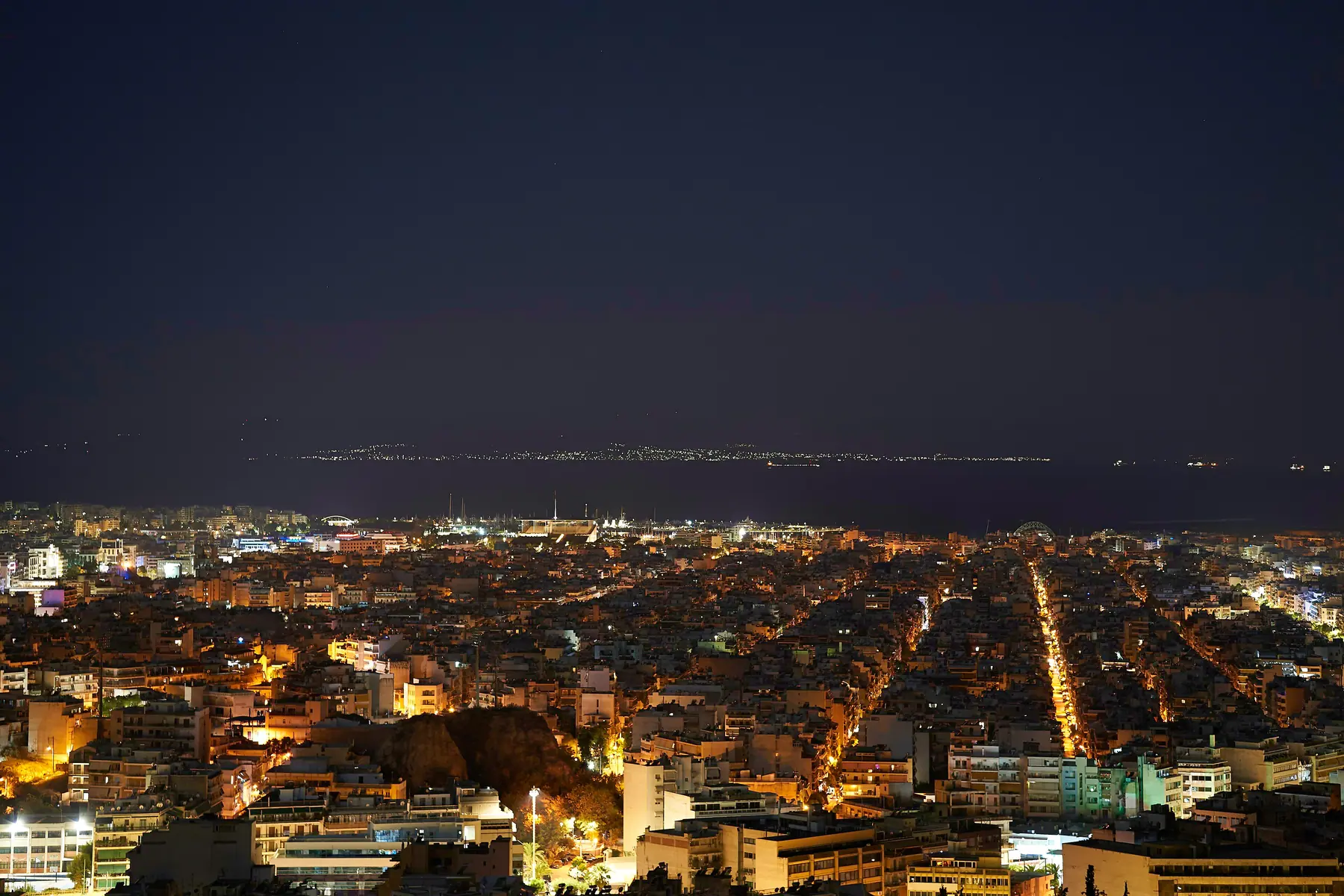
Athens: the gateway to the islands, and a night at each end
The gateway to almost every island and a city worth a night at each end of the trip, rather than an airport to pass through.
Athens is not a stop on the way to the islands so much as the mechanism that makes the islands reachable. Piraeus is the largest passenger port in Europe, and the sailings that leave it in the morning reach almost everything in the Cyclades, the Dodecanese and the north-east Aegean given enough hours. That is why so many island routes are built with a night here at each end: the outbound night is the connection, and the return night is the insurance against a cancelled crossing.
It is also a city that rewards being treated as a destination for a day or two rather than a transit lounge. The centre is compact and walkable, the ancient sites sit inside it, not beyond it, and a single archaeological ticket covers the Acropolis together with the Agora, the Roman Forum, Hadrian’s Library, Kerameikos and the Temple of Olympian Zeus. The pattern that works is one long morning of ruins, an afternoon out of the heat, and the evening in the streets, which is roughly how Athenians use their own city in summer.
Things to do
Athens sightseeing - This tour gives you the opportunity to observe the striking contrasts that make Athens such a fascinating city. An expert guide will take you to see the centre of the city including Constitution Square (Syntagma), the House of Parliament, the Memorial to the Unknown Soldier, and the National Library.
The drive down Herod Atticus Street reveals the Evzones Guards in their colourful uniforms and the Presidential Palace. On your way to the Acropolis you will see the Panathenaic Stadium where the first Olympic Games of the modern era were held in 1896, the Temple of Olympian Zeus and Hadrian’s Arch.
On reaching the Acropolis you will visit the museum and the architectural masterpieces of the Golden Age of Athens including the Propylaea, the Temple of Athena Nike, the Erechtheion and the Parthenon.
Getting there
Athens takes direct flights from Bristol, Edinburgh, Manchester, Heathrow and Gatwick. Most other UK regional airports connect with one change en route.
The metro runs from the airport to Syntagma in the centre in about forty minutes, and the same line continues to Monastiraki. For the ferries, change for Piraeus, which is the end of the oldest line. Budget an hour and a half from landing to being on a boat, more with luggage and a ticket queue.
Do you have to spend a night here?
Not always, but it is usually the better plan. Ferry departures cluster in the morning and the early evening, and a flight that lands in the afternoon frequently misses both. A night in Athens turns an awkward connection into part of the holiday.
What should you see with one day?
The Acropolis, and then the Acropolis Museum below it, which holds what came off the rock. The pedestrianised walkway of Dionysiou Areopagitou skirts the south slope past the Theatre of Dionysus and the Odeon of Herodes Atticus, and continues towards the Temple of Olympian Zeus and Hadrian's Arch.
And with two?
The National Archaeological Museum, which is the finest collection of Greek antiquities anywhere and is routinely skipped by people who only came for the Acropolis. Then the Panathenaic Stadium, where the first modern Olympic Games were held in 1896, and the climb up Lycabettus for the view over the whole basin.
Where should you stay?
Plaka and Monastiraki put you inside the old city and within walking distance of everything, at the cost of noise and crowds. Koukaki, on the far side of the Acropolis, is quieter and residential and still ten minutes' walk from the site. Psyrri is the middle option and the liveliest after dark.
What is worth seeing that is not ancient?
The central market on Athinas, which is a working meat, fish and vegetable market, not a tourist one, and the tiny district of Anafiotika, built into the north slope of the Acropolis by settlers from Anafi and looking more like a Cycladic village than a capital city.