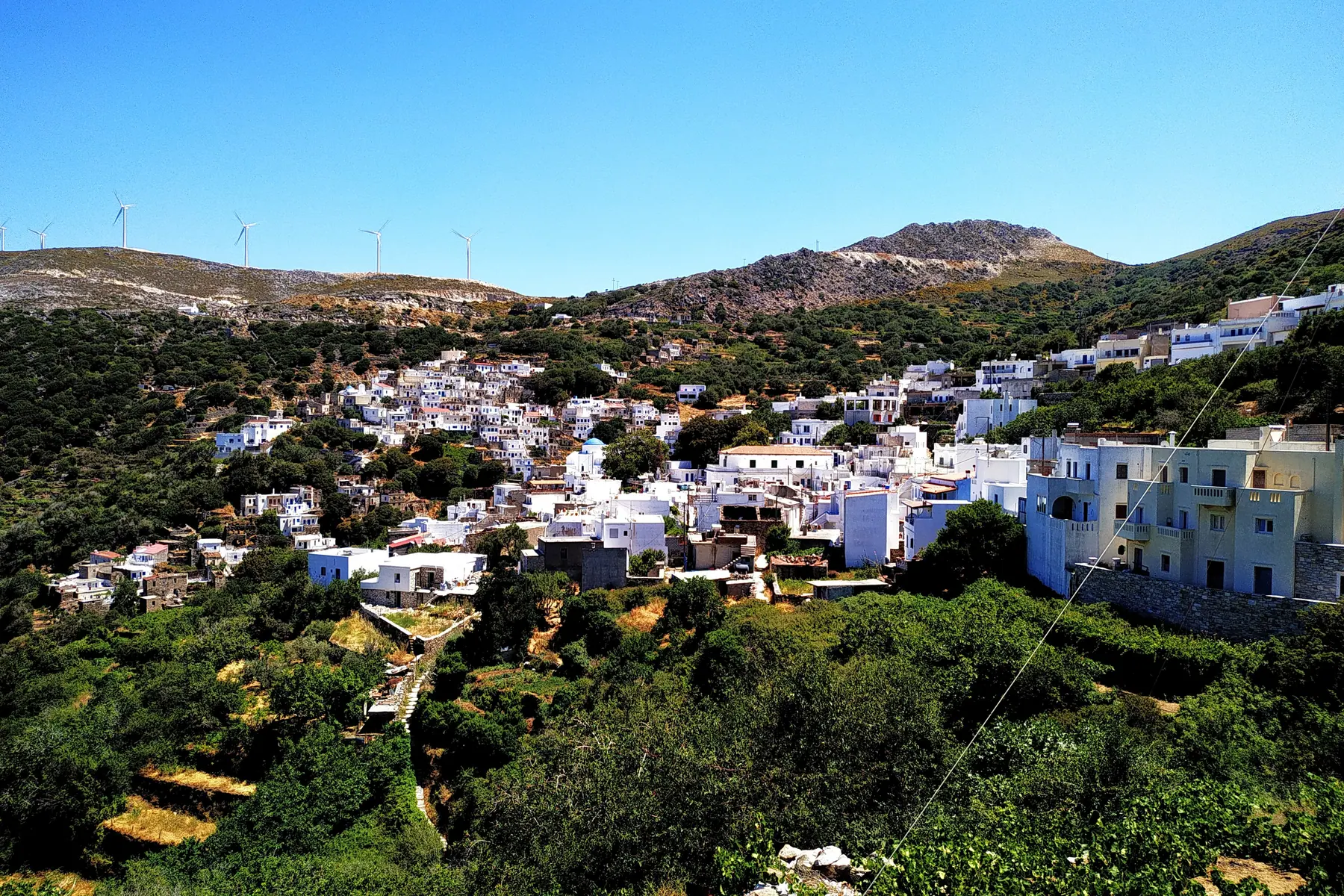
There is more to see and do on Naxos than its neighbours let on, and it is the largest island in the Cyclades. From the quaint, narrow alleyways of Chora, the main town, to the gorgeous empty, sandy beaches of the west coast, Naxos will reveal its full beauty if you are prepared to move around.
A good place to start is the Kastro in old Chora. The narrow, fragmented covered streets with many twists and turns reveal dead ends, corbels and balconies. Beautiful churches vie with attractive courtyards and mansions festooned with flowers. The archaeological museum is home to artefacts from as early as the 3rd millennium BC. Getting lost is not an option, as all paths and roads will eventually lead steeply down to the harbour front. Although not eye-catchingly attractive as some Cycladic port town promenades, Chora does possess many excellent tavernas, with evening revelry limited to plenty of cafes and bars. A short stroll from the harbour front, over a small headland and you reach the sandy, town beach of Agios Georgos. Carpeted with beach umbrellas and loungers at the town end, more seclusion is assured if one continues to amble round the long sweeping, sandy bay, passing various watersports possibilities along the way including waterskiing and windsurfing.
South of Chora, the Naxos coastline is dotted with superb, sandy beaches. Agios Prokopios is one such area, linked to Chora by a regular bus service taking about 10 minutes. A magnificent swathe of golden yellow sand is fringed by a good selection of eating and drinking establishments. Water sports enthusiasts will not be disappointed, nor will beach-lovers who will be able bask in the neighbouring sandy bays of Agia Anna and Plaka both of which have their own microcosm of tourist facilities, including tavernas, cafes and mini-markets. Travel almost as far as one can on asphalt southwest of Chora and one reaches beach heaven at Kastraki. Photographs undersell this stretch of the Naxos coastline: mile upon mile of sand, and remarkably little of the traffic such a coast usually attracts. If your idea of a great holiday is lazing on great beaches, snorkelling among rocky outcrops, exploring shallow rock pools and eating in secluded, tree shaded tavernas, you will not be disappointed. Keen windsurfers can walk to the neighbouring bay of Mikri Vigla to indulge themselves at the school based there.
Naxos can be combined with Athens, Amorgos, Astypalea, Donoussa, Iraklia, Koufonissia, Paros, Antiparos, Santorini and Schinoussa.
What Naxos Greece is like
Naxos Greece divides cleanly in two. The west coast is sand, more or less continuously, from the town beach at Agios Georgios down past Agios Prokopios and Agia Anna to the empty stretches at Kastraki. The interior is mountain: terraced valleys, marble quarries, and villages that were here long before anyone came for the beaches. Most visitors see the first half. The second is why people come back.
The beaches, north to south
The Naxos beaches run the length of the west coast and get quieter the further south you go. Agios Georgios is walkable from Chora and busy at the town end. Agios Prokopios, ten minutes by bus, is the first of the long ones. Beyond Agia Anna and Plaka the development thins until Kastraki, where the beaches are measured in miles rather than metres. Anyone judging Naxos beaches by the town beach alone has seen the least of them. Naxos island has more sand than any other Cycladic island and most of it is south of the Chora.
The Chora and the mountain villages behind it
The Chora is the old town under the Venetian kastro, a maze of covered lanes and courtyards that resolves, eventually, downhill to the harbour. Behind the Chora the mountain villages begin: Halki in the Tragea olive groves, Apiranthos in marble, Koronos on its ravine. A car reaches all of them in a day. Those villages are where Naxos Greece stops being a beach island and becomes an island with beaches, and they are the half of Naxos island that repays a car.
Things to do
Naxos offers a very wide programme of excursions and activities. Coach tours around the island are the easiest way to appreciate the ancient monuments and natural beauty of Naxos.
There is also a walking tour of the Venetian Castle in Chora. The more active may want to join one of the 4 walks with guide. The areas of Naxos that are included in these walks are the Olive Groves of Tragea, the river of Kinidaros, the villages of central Naxos and the area of Sangri with its Venetian towers and temple of Demeter.
A horse riding centre is based in Kastraki offering everything from 4 hours riding in the Kastraki area (beginners are welcome) to more adventurous journeys for 1 or 2 days.
Out on the water, windsurfing, water-skiing and jet skiing are all readily available. Boat excursions are also numerous. Daily caique boats visit the virgin beaches of southeast Naxos which are inaccessible by land whilst larger vessels visit Mykonos/Delos, Paros, Santorini and Koufonissia/Iraklia.